
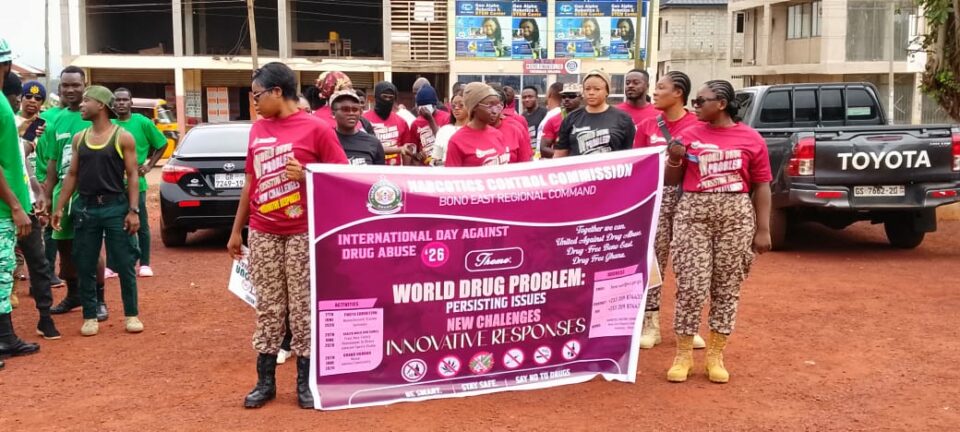
The Bono East Regional Commander of the Narcotics Control Commission (NACOC), SNCO Portia Abuwie Demuyakor, has reiterated that the fight against illicit drugs requires collective action, stressing that drug abuse affects individuals, families, communities and the nation’s development.
She made the call during an anti-drug awareness float through the principal streets of Techiman as part of activities marking the 2026 International Day Against Drug Abuse and Illicit Trafficking.
The colourful float, which brought together personnel from the Ghana Police Service, Ghana National Fire Service, Ghana Immigration Service, Ghana Prisons Service and other security agencies, attracted hundreds of residents who lined the streets to witness the campaign. Participants displayed placards with anti-drug messages while interacting with members of the public and educating them on the dangers associated with illicit drug use.
The event was also characterized by excitement and entertainment as the various security agencies engaged in friendly games and an energetic dancing competition, creating an atmosphere of unity while reinforcing the campaign’s message of promoting drug-free communities. The performances drew loud cheers from spectators, demonstrating that public education can be effectively combined with entertainment to reach a wider audience, especially the youth.

Addressing the media, SNCO Demuyakor noted that June 26 of every year is set aside to commemorate the International Day Against Drug Abuse and Illicit Trafficking, create awareness about the dangers of illicit drugs and encourage collective action against drug abuse.
According to her, the Bono East Regional Command of NACOC had, over the past two weeks, embarked on radio discussions and community outreach programs to sensitize the public to the harmful effects of illicit drugs and the significance of World Drug Day.
”June 26 of every year has been earmarked to commemorate the International Day Against Drug Abuse and Illicit Trafficking, create awareness about the dangers of illicit drugs, and encourage collective action against drug abuse.
”As part of this year’s commemoration, the Bono East Regional Office of the Narcotics Control Commission (NACOC) has lined up a series of activities to mark the occasion successfully.

”About two weeks ago, we commenced radio discussions and community outreach programmes to sensitize the public to the harmful effects of illicit drugs and the significance of World Drug Day. Today, with the support of all the security agencies in the region, we have embarked on a float through the principal streets of Techiman to further spread this important message.”
She explained that the fight against illicit drugs is a shared responsibility because their effects extend beyond users to families, communities and the nation at large.
She disclosed that the activities lined up for the commemoration would continue with a seminar and climax with a community durbar at Amoma under the theme, “The World Drug Problem: Persisting Issues, New Challenges, and Innovative Responses.”
”The fight against illicit drugs is a collective responsibility because their effects impact individuals, families, communities, and the nation as a whole. Following the float, we will organize a seminar and conclude the activities with a community durbar at Amoma under the theme: “The World Drug Problem: Persisting Issues, New Challenges, and Innovative Responses.”

The Regional Commander explained that society’s approach to people battling drug addiction has evolved, emphasizing that scientific research and practical experience have shown that addiction should be treated as a condition requiring counseling, rehabilitation and treatment rather than neglect and stigmatization.
”Gone are the days when individuals who used illicit drugs were neglected and stigmatized. Scientific research and experience have shown that people struggling with drug addiction need support through counseling, rehabilitation, and treatment to overcome their dependency.
”The Narcotics Control Commission has opened its doors to anyone battling drug abuse. We have qualified counselors who are ready to help individuals stop using illicit drugs and other harmful substances. At NACOC, we believe that if we can rid Ghana of illicit drugs, our society will be safer and our youth will have a healthier future.”
She further explained that the Commission operates through three main units: the Enforcement and Intelligent Unit, the Education Unit and the Counseling Unit.

According to her, the Enforcement and Intelligent Unit is responsible for enforcing laws relating to illicit drugs and other prohibited substances by investigating offences and arresting offenders, while the Education Unit undertakes public education campaigns in schools, churches, mosques, markets and communities to discourage drug abuse.
”The Enforcement and Intelligent Unit is responsible for enforcing the laws relating to illicit drugs and other prohibited substances. Despite continuous public education, some individuals still engage in the trafficking and distribution of illicit drugs, which is against the laws of Ghana. The unit ensures compliance with these laws by investigating offences and arresting offenders.
”The Education Unit is responsible for educating the public about the dangers of illicit drugs and encouraging people, especially the youth, to stay away from them. The unit regularly visits schools, churches, mosques, markets, and communities to conduct educational campaigns and street awareness programs.”
She added that the Counseling Unit provides counseling and rehabilitation support to individuals struggling with drug addiction, helping them overcome substance dependency and successfully reintegrate into society.\
”The Counseling Unit provides counseling and support services to individuals who are already using illicit drugs, helping them overcome addiction and reintegrate into society.”
The successful float, games and dance competition highlighted the commitment of the security agencies and the Narcotics Control Commission to raising awareness through innovative and community-centred approaches, while encouraging residents to support efforts aimed at building safer and drug-free communities.
Source: Newspyramid.com
