
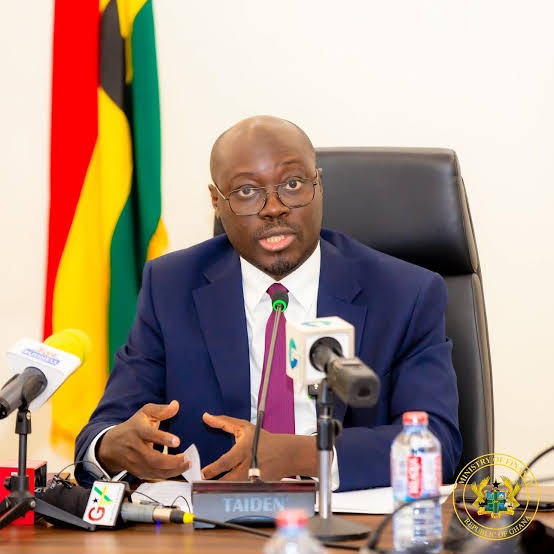
Finance Minister Dr. Cassiel Ato Forson has said the Mahama administration inherited an economic management system that had failed, making it necessary to pursue sweeping reforms instead of continuing with previous policies.
Speaking on the government’s economic reform agenda, Dr. Forson said the administration quickly concluded after assuming office that Ghana’s economic challenges could not be addressed through conventional structural adjustments alone.
He explained that the government adopted a comprehensive package of policies aimed at delivering transformational change, arguing that maintaining the previous approach would have further worsened the country’s economic situation.
“When we took office, it was immediately clear to us that the old model of economic management had failed and that Ghana did not only need structural adjustment; we needed transformational change.” He said.
According to the Finance Minister, the government’s first priority was to restore fiscal discipline by taking full control of public finances through what he described as “fiscal correctness.”
Dr. Forson disclosed that the government introduced a commitment authorization system to ensure that ministries, departments, agencies (MDAs), state-owned enterprises (SOEs), and other covered entities spend strictly within their approved budgets.
Under the new arrangement, he explained, public institutions must obtain commitment authorization before entering into financial obligations, preventing them from committing the state to expenditures beyond their budgetary allocations.
He noted that under the previous system, many public institutions, particularly SOEs, accumulated debts and contractual obligations without adequate financial backing, leaving the government to absorb the liabilities.
Dr. Forson revealed that over the past decade, state-owned enterprises have added contingent liabilities equivalent to about 3 percent of Ghana’s Gross Domestic Product (GDP) annually, significantly increasing the country’s debt burden.
“In the past, ministries, departments and agencies, and even state-owned enterprises, could live above their means. They signed contracts they could not finance, failed to honour their obligations, and eventually the state had to assume responsibility for those debts.” He said.
He stressed that the annual liabilities created by SOEs over the last ten years exceeded the country’s yearly capital expenditure, underscoring the need for stricter financial controls to safeguard public finances.
Dr. Forson maintained that the government’s fiscal reforms are designed to prevent reckless spending, improve accountability, and place Ghana’s economy on a sustainable path toward long-term growth.
Source: Newspyramid.com
